Showing posts with label Festivity: Other. Show all posts

Sunday, 5 April 2009

Polish carrot-poppy roll cake

Polish: marchew
Gujarati: ગાજર
Hindi: गाजर
Marathi: गाजर
Punjabi: ਗਾਜਰ
Sanskrit: गृञ्जनकम्
Tamil: காரட்
Telugu: గాజర గడ్డ
Urdu: گاجر

Carrots, again :) Can there be something more Polish than poppy seed, roll cake and carrots? Well yes, mead, buckwheat, beetroots... and so on... Oh well... Anyway, I guess lots of people consider poppy seed a typical central and eastern European ingredient and they are just right. There are millions of poppy seed recipes (cakes, pies, buns, dumplings and so on). My today's recipe is called marchwiak. Well, marchew means just carrot in Polish. Marchwiak is a roll cake with carrot-poppy filling from Lubelszczyzna, a beautiful region of eastern Poland, with Lublin as its capital city. Marchwiaki were traditionally baked for All Saint's Day. A very similar yeast roll cake, but with other filling (apple-poppy) was baked by my grandmum (she comes from Podlasie, a region next to Lubelszczyzna; to see more pictures of this beautiful region of Poland, visit a stunning blog with awesome pictures from Podlasie. More pictres for example here. Pictures from Lubelszczyzna can be found here)

500 gr flour
50 gr fresh yeast
1/2 cup milk
1/2 cup water
1/2 cup sugar
2 egg yolks
1 egg white
1 egg
a pinch of salt
1/4 cup lard (melted)
3/4 cup grated carrot*
1 handful poppy seeds
(optionally add 1 tablespoon grated orange or lemon zest - it is not included to the traditional recipe, but it will improve the taste deffinitely)
icing: icing sugar + lemon juice
few poppy seeds more to sprinkle

1. Heat the milk (but don't boil it), add yeast, sugar and 1 tablespoon flour. Set in a warm place and let it grow.

2. Sieve flour, add yeast, water, whisked 2 yolks with 1 egg, salt and melted lard (everything in room temperature, as it always should be when baking yeast cakes!) and knead the dough. When everything combines well and you obtained elastic dough, form a ball and let it grow in a bowl. When it doubles its surface, knead again. I did this point in a bread machine (kneading and growing program)

3. Sprinkle your workplace with some flour. Now decide if you want 2 rolls or 1 roll and six lovely buns. In next point I will first continue about how to make roll cake.

4. Roll the dough (actually, roll only a half of your dough; the second half is to make a second roll or sweet breakfast buns - or just reduce the proportions, which I never made, cause I always prepare a roll cake and breakfast buns :P)

5. When your dough is rolled into 0,5 - 1 cm thick, smear it with egg white. I do it always in Christmas poppy seed or nut roll cakes to avoid gaps between dough and filling. Now, sprinkle it with grated carrot and a handful of poppy seed (and optionally lemon or orange zest, which is highly recommended and, if you wish the roll to be sweeter, sprinkle with 1 tablespoon sugar)
* 3/4 cup is to fill 1 roll cake. prepare also another 3/4 cup to fill the second roll if you decide to bake 2 rolls


6. Now slowly fold the dough. Put it gently on a sheet of baking paper. Sprinkle with the resting few poppy seeds. Bake in 180C oven about 30 minutes or until golden brown.

7. Prepare the icing my mixing lemon juice with icing sugar and pour it on already cooled roll cake.


8. About sweet breakfast buns - after kneading-growing process, just form lovely round-shaped buns (I make six) and let them grow for a while. Smear with egg white and sprinkle with poppy seeds and bake until golden brown. I don't have any picture of them, my family was too fast :(

Sunday, 22 March 2009

Israeli date pastries

Polish: daktyl
Portuguese: tâmara
Xhosa: umhla
Sicilian: rattula
Romanian: curmală
Azeri: xurma
Arabic: تَمْر
Kurdish: salroj
Malay: buah kurma
Mokshan: fig

Mammouls are delicious stuffed pastries, eaten in the whole Near East. They can be filled with dates, walnuts, pistachios, dates with sesame seeds and so on. they are a festivity cookie, eaten (depends on religion of the eater and on the filling) during Easter, Ramadan, Hanukkah and Purim. I ate once great Lebanese mammouls with pistachio filling in the most important moment of my life and that is why I will never forget its taste. Again, using great Elizabeth Wolf-Cohen's book "Jüdische Küche", I prepared Israeli mammouls (מעמול) with date filling and they were incredibly tasty and similar to the Lebanese ones I ate. However, Jewish and Arab recipes differ and I will show you Arab recipe another day, too.

(to make 12 pastries)
175 gr flour
2 tablespoons sugar
2 tablespoons milk
1+1 tablespoon orange blossom essence
90 gr soft butter
100 gr pitted dried dates
icing sugar to sprinkle

1. Combine flour with sugar. Add milk, orange water and butter and knead. Optionally, add few more milk but don't add too much cause the dough can't be sticky! Form walnut-size balls (I made 12).

2. Prepare the filling: chop dates finely and add orange blossom water (or optionally a bit of water to make the consistency better, but I just soaked dried dates in water before chopping them and it made everything easier, I simply strained them and chopped)

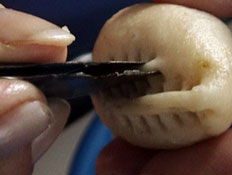
3. With your fingers, make a hole in dough balls and stuff each ball with a teaspoon of the filling. Close the balls and form them anyhow you wish. Mammouls can be formed with special wooden molds like these or you can shape them in your hands with a help of tongs (see also here , here and here). To inspire yourself, take a look at these pics: 1, 2, 3, 4, 5, 6.
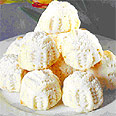
And here are my no-mould-no-tongs-hand-made mammouls :)


ps. my mum asked me to make mammouls with our homemade chokeberry jam as a filling. I guess I'd like to experiment, I am sure it would taste great!

Monday, 23 February 2009

some Polish traditional sweets

Dear food lovers!
The blog is 1 year old. I abandoned it for some time but now I am back and ready to share recipes and pictures again. Thank you for the comments and for asking to continue the blog. I'll try to do my best :) Especially about Polish cooking.

I had 5 culinary opportunities left (opportunities to bake something special and celicious, of course): All Saints Day & Polish Independence Day, my birthday, Christmas, New Year and carneval (mardi gras or "thick thursday", tłusty czwartek", as it is called here in Poland... I was gathering recipes and pics I made in the meantime and will show you some of them.

1st November is when you find more people at the cementary than at the street, at least here in Warsaw. People bring tons of candles and flowers, clean tombstones, prey, have a walk. It is a kind of magic time and I like to spend that day at Powązki Cementary to visit Polish soldiers, actors and writers. I always bring home cementary sweets: round hard dry buns with a hole inside, bound like a chaplet with a twine, called obwarzanki and hard white and red stripped candies called pańska skórka. Pańska skórka is a regional candy from Warsaw, sold especially in November, but lately also anytime at the old town square, and its recipe is top secret. Obwarzanki can be bought even in supermarkts, but only the crispy thin variety; the obwarzanki that look like tiny buns are available only during the Independence Day and at the cementery.
Here you can see obwarzanki (thick version), prażynki (those big crispies) and szyszki (puffed rice balls with caramel, called "cones")


even if homemade puff rice szyszki look and taste so differrent because of higher content of caramel or chocolate:


If you have some obwarzanki (maybe from Polish or Russian markt) and wanna eat them in an old Polish way, just soak them for 1 hour in sweet red wine (eventually in milk). When they are soft, fry them in butter. Sprinkle with icing sugar and eat warm.


Take a look at some regional delicacies from the beautiful city Poznań. I was there with my brother in November and of course we brought home Rogale Świętomarcińskie (St.Martin croissants). 11 November, together with Polish independence Day, is also St.Martin Day. In ancient pagan tradition that day's tradition was to offer ox or an ox-horn-shaped bun. Catholic church adopted this tradition by joining it with St.Martin and the bun's shape was just a symbol of St.Martin's horse's shoe. The filling is made by a special white sort of poppy and differrent dried fruits. Here it is, together with delicious crunchy "tube" cakes (rury) and a special, "fried" cheese -serek smażony- another Wielkopolska and Silesian tradition: curd cheese fried with caraway.


And than... end of December came. Like all food lovers, I was using this great opportunity to bake kilograms of delicious cakes, cookies, gibgerbreads and all this kind of stuff. Take a look at my Christmas ginger cookies :)


The last thursday of carnaval (the last thursday before Ash Wednesday) is called tłusty czwartek (fat thursday). This day you HAVE to eat pączki, Polish donuts, and a kind of long sweet fried pieces of thin dough, called faworki or chrust (literally, brushwood).


The same dough can be formed into roses and baked. Roses are called róże karnawalowe. Believe me or not but shape determines the taste (in noodles or fried dough... really!)

Queues to buy those delicacies are soooooo long! It is great to make them at home but both are quite complicated to prepare. The best pączki in Warsaw are from Blikle, but my mum makes great ones, too. But this year we had no time to prepare them for thursday, but there still is the last chance to eat them on Ostatki (Mardi Gras, the last day before Ash Wednesday, which is in Poland a day of fasting and you should eat only 1 full meal, but without meat, eggs or dairy products). Ostatki are tomorrow so keep your fingers crossed so that we manage to fry my mum's pączki and you will get the most wonderful recipe in the world :) Until now, take a look at Blikle donuts.


Tuesday, 2 September 2008

Egyptian fried pastries

Polish: Ramadan
Albanian: Ramazani
Lithuanian: Ramadanas
Greek: Ραμαζάνι
Kazakh: Рамазан
Arabic: رمضان
Persian: ماه رمضان
Portuguese: Ramadão
Wolof: Koor
Telugu: రంజాన్

The Muslim Holy Month begins. Every laic knows it is about fasting. Of course fasting is only one of the exterior manifestations and Ramadan means much more than fasting only. And, fasting doesn't mean abnegation of all delicacies, quite to the contrary, after the sunset, delicious sweets are, well, maybe not obligatory but more than welcome. One of them is called dates from Siria, balah el Sham, Egyptian sweet fried cakes.

dough
1/2 cup oil (you can give less!)
1 cup water
1 1/2 cup flour*
4 eggs
vanilla sugar (1 pack)
a pinch of salt

sirup
1 cup sugar
172 cup water
lemon juice (about 1 tablespoon or to taste)
+ coconut flakes (1/2 - 1 cup)

1. Pour oil and water in a saucepan, add salt and bring to boil. Sift flour and stir until you obtain a plain dough which doesn't stick to the pan. Set aside to cool a bit.

2. Prepare syrup by cooking the ingredients (sugar, water and lemon juice) together. When thick, set aside to cool.

3. Whisk eggs with vanilla sugar. When oil dough is template, you can start adding egg mass little by litte while stirring constantly. Check the consistency; the dough has to be quite thick. If needed, *add some more flour.

4. Place the dough into a pastry bag with a star shape tip. Press the dough into frying oil and fry until golden brown but on a low heat. Otherwise your dates will be crispy outside and raw inside! When ready, put them on a paper kitchen towel to avoid excessive oil contain. When still warm, deep them into the syrup for some minutes. You can deep warm dates in cold sirup or cold dates in warm sirup. Then roll in coconut flakes.

My balah el sham are a bit long, almost like Spanish churros. They are traditionally about 3 cm long.

Pictures will be available very soon. I just have to find them on my pendrive :)

Edit: I have the pics now. The quality is not the best but the pics are just to give you the idea about this dish :)