Showing posts with label Festivity: Easter. Show all posts

Friday, 17 April 2009

Polish Easter

Polish: Wielkanoc
Kashubian: Jastrë
English: Easter
Albanian: Pashkët
Mokshan: Очижи
Lithuanian: Velykos
Georgian: აღდგომა
Ossetian: Куадзæн
Swabian: Auschdra
Croatian: Uskrs

Easter breakfast is the most important thing about celebrating Easter in Poland. Everyone wakes up very early and participates at Rezurekcja (6 o'clock a.m. Holy Mass); the naive one who plans to be lazy and sleep longer rather won't be able to, cause at this time you will hear everywhere clangor of special instruments, petards, bells and so on. After that, at least in my family, men prepare and decorate breakfast table while women bake white sausage, season żurek and decorate meals. However, almost everything is already done. Pisanki are painted, żur is already sour, babka is waiting to be served... A culinary must are: żurek, sour rye soup (eaten with chunks of white sausage and boiled eggs, often served in cored little breads), baked white sausage, eggs and babka with mazurek, two kinds of cakes, a flat and a tall one. Often people serve pascha, curd cheese dessert, and chałka, hallah bread. There is actually no other meal this day, people just sit together, start eating breakfast, talk, spend lazy time, heat resting żurek and kiełbasa for dinner and leave the table only to cut some more bread or to boil new portion of tea.

see also: pictures of my family's 2008 Easter breakfast dishes


This year my family's Easter menu was:

* żurek - sour rye soup (for more details, visit the previous post). Sometimes can be replaced by horseradish soup, sometimes people cook a fusion of both: a delicious horseradish żur. The main thing is a sour taste!)
* pieczona biała kiełbasa - baked white sausage
* rolada szpinakowa - spinach & smoked salmon & horseradish cheese roll
* chicken-vegetable (pea, bean, corn, radish etc.) salad
* ser jajeczny - egg cheese (eggs cooked with milk until curdles; looks like cheese, tastes like eggs, traditionally eaten with horseradish sauce)
* jajka - hard-boiled eggs (plain or marinated in beetroot juice) with mayonnaise
* homemade bread
* chałka - hallah
* puff pastry poppy seed pigtails
* babka (egg-yeast tall traditional cake, this year with coffee flavour and coffee icing)
* mazurek (the flat cake; this year with Easter rabbit)
* cooked (yes! not baked! just cooked!) cheesecake with poppy seed-coconut roll cake
* pear-jelly-biscuit cake
* homemade butter
* ćwikła (horseradish with beets), horseradish sauce, red and black kaviar
* sos tatarski - tartar sauce (mayonnaise, sour cream, horseradish, chopped pickled sour cucumbers, capers, champignons, hard-boiled eggs, chives, lemon juice)
* slices of fresh vegetables, homemade pickled mushrooms
* homemade (preserved) cherry juice (kompot wisniowy)

bread, tartar sauce, eggs and egg cheese:


beet-dyed-eggs and egg cheese:


mayonnaise eggs, homemade butter, spinach roll:


spinach roll:


chicken-vegetable salad with duck-egg on the top, sauces and kaviar:


mushrooms and garden cress:


chałka:


mazurek:


pear-jelly-biscuit cake:


raspberry pascha:


babka:


cooked cheesecake hidden in poppy seed-coconut roll:


An important ingredient of eastern breakfast is a plate full of differrent sausages, just like these

Traditional Easter decoration are: garden cress and oat grass, box twigs, willow twigs with catkins, daffodils, myrtle, little lambs (symbol of Jesus Christ) and obviously pisanki, which are eggs painted, dyed, scratched, decorated with bulrush pith or painted with melted wax

Tuesday, 14 April 2009

Polish sausages

I guess I am a lucky person, because my mother's family comes from the countryside. We go there not as often as we'd like to, but at least twice a year, for Christmas and Easter, and it is when we taste homemade sausages, my grandmother's hen's eggs and fresh milk. Here you can see examples of homemade eastern Polish delicacies, always eaten for Easter, but also for a simple breakfast :)

from the top of the page to the right: słonina (salo), polędwica (tenderloin), pasztetowa (liverwurst), kaszanka (black pudding), boczek (bacon), boczek faszerowany (stuffed bacon)


here: szynka (ham) and kiełbasa (well... even in English people say kielbasa...)


this is how people in eastern Poland (Mazovia-Podlachia) usually eat Polish black pudding (kaszanka), a blood-buckwheat sausage: mashed and fried, with fried onion slices, few chopped parsley, sour cucumber slices and bread (often rye bread)


and here, an obligatory sausage for Easter breakfast: biała kiełbasa (white sausage). At home, for Easter breakfast, we:
a) cook it in a famous Easter sour rye soup called żur or żurek (we serve żurek with thick slices of biała kiełbasa and hard-boiled egg. Żurek can be also served in bread);
b) bake it in the oven with rings of onion (like on the picture below)

Sunday, 12 April 2009

Happy Easter!!!!!!!!!!

HAPPY EASTER!!!!!
SZCZĘLIWYCH SWIĄT WIELKIEJ NOCY I WESOŁEGO ALLELUJA!!!!!


Sunday, 29 March 2009

Waffle cake tutorial + vanilla filling

Wafer cake (torcik waflowy, sometimes called pishinger) is very popular in Poland, but also in Russia and probably other east-european countries. Simply wafer sheets filled with differrent kind of creams. Thanks to Feedjit I know that many internauts visit my blog in search of filled wafer cake recipe, and I know that some of you make this cake in a wrong way. That is why I decided to give you a kind of tutorial, to explain you step by step how to prepare this delicious, simply no-bake cake.

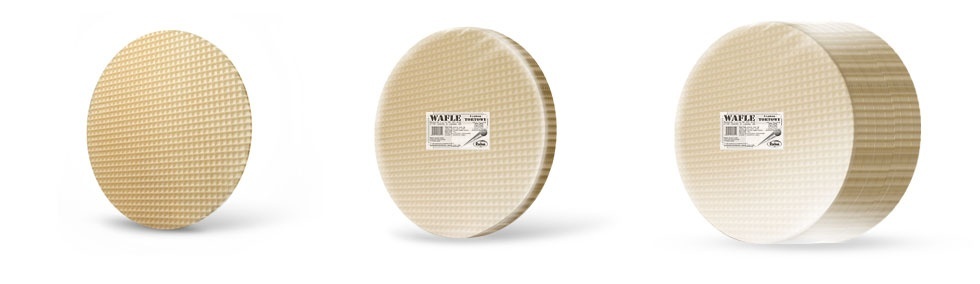
First of all, you need big wafer sheets (outside Poland, available in Polish or Russian groceries) -> like these or these. There are even heart-shaped waffles :) Don't you believe me? Go and see what a Polish blogger made with her waffles in a free time :)

Secondly, you have to choose the filling. There are plenty of differrent fillings, for example:
- toffee filling (or more extravagant: toffee with cookies)
- fruity filling
- helva filling
- peanut cream filling*
- eggnog cream filling
- honey cream filling
- lekvar-choco filling
- cacao cream filling
- vanilla cream filling
The most popular fillings in Poland are toffee filling (cook a can of condensed milk for 3 hours in a pot with water, open the can, beat the toffee that you just obtained with some soft butter) or powdered milk-based cacao cream. I promise to show you in the future more differrent filling recipes.
*this filling is delicious but you need to double or triple this recipe to be able to fill 1 pack of wafer sheets

Third thing is decoration. You can just leave undecorated filled wafers and cut them into diamonds, or spread with chocolate glaze and sprinkle with chopped nuts (other ideas are more than welcome). Torcik waflowy is often made for Easter and decorated just like mazurek, a famous Polish Easter cake. Just decorate waffle cake like mazurek or cut it into a shape of egg and decorate - like here or here.

Ok. If you already have made your plans, let's start!

1. Prepare enough cream (better more than less). At least 2 cups of cream for 1 pack of waffles.

2. Smear cream on waffles, when it is still warm! Don't skimp it, remember to cover the whole waffle with about 5mm of filling! Start from the inside.


Remember, begin with a wafer sheet and end with a wafer sheet - cream should stay inside! Cause...

3. ...cause when you are done with smearing waffles, now you have to wrap your cake into a baking paper or culinary aluminium paper. Leave it in a cool place and load it by putting a heavy big enciclopedia on the top of the wrapped cake! If not, soft (by a warm cream) waffle sheets will probaly deform. By loading our cake, it stays well-shaped and the filling glues wafer sheets (but remember, just like I said before, each sheet needs a lot of filling!) the best would be to leave the cake overnight but if not, than at least 2 hours. After that time, sheets will stay soft and the filling won't run down by cutting the cake!

4. Only now you can cut your cake into diamonds (or any other portions) and put on a plate or... decorate it and serve without cutting.

Now the fifth filling option (after toffe, fruity, helva and peanut filling), the one my mum got from my aunt Basia, who makes the best cakes of the world: sweet and delicious milky vanilla filling

1 cup milk
1 cup sugar
250 gr margarine (important: no butter!)
3 cups powdered milk*
few drops vanilla flavouring
(optionally: 1/2 teaspoon cocoa. If you add 3-4 tablespoons pure cocoa powder, you'll obtain vanilla-cocoa cream)
*If your cream is thick enough, you can add a bit less powdered milk. Or, take 2 cups powdered milk and 1 cup ground walnuts/almods/coconut flakes!

1. In a saucepan, bring to boil milk, margarine and sugar. Pour into a bowl and gradually add small amounts of powdered milk (nuts, cocoa) and flavouring and stir well all the time (make no clumps!). Smear waffles... well... and follow the tutorial instructions above (from point 2) :)

2. Optionally, melt 100 gr milk chocolate with 25 gr copha (coconut fat), decorate the cake, sprinkle with chopped nuts, decorate with nut halves, candies, coconut flakes or anything you like! It's really delicious!


Thursday, 12 March 2009

Polish horseradish soup

Polish: chrzan
Ossetian: туттургъан
Hebrew: חזרת הגינה
faroese: piparrót
Galician: labestro
Spanish: rábano picante
Greek: αγριοραπάνια
Estonian: mädarőigas
Latvian: mārrutka
Ukrainian: хрін

Horseradish is an important ingredient of Easter menu in Poland. I am slowly composing Easter menu, so last week I was trying a regional recipe for a horseradish soup from southern Poland highlander town, Lanckorona (chrzanówka lanckorońska), to be able to choose the best soup for Easter breakfast. I recommend this spicy soup to all fans of horseradish, turnip, rutabaga, garden cress and radish.

see also: Polish whey-millet soup
see also: Moldovan whey soup

1l whey*
5 tablespoons freshly ground horseradish
5 tablespoons sour cream
1 tablespoon flour
2 garlic cloves
3 eggs
1 teaspoon lovage
salt, pepper to taste
(+ originally ribs and a bit of sausage)

1*. Don't have whey? To obtain about 1l of whey, take 1,5l milk and 2-3 tablespoons vinegar or lemon juice. Bring milk on a low heat with vinegar/lemon juice without boiling, until it curdles. This is it, now you have to separate curd from whey using a fine sieve. (Of course, don't throw the curd, just eat it with scallions, dill and garlic on a slice of fresh bread!)


2. In a saucepan, put ribs and sausage (or a vegetable stock cube), ground horseradish and chopped eggs. Pour whey over the ingredients and slowly bring to boil. Season with salt and pepper. Take the meat off.

3. In a bowl, perfectly whisk flour with sour cream to omit lumps. Add 1 cup of your warm soup from the pan and whisk again. Now add this mixture to the soup and cook. Add lovage and ground garlic 1 minute before serving.

4. Serve with cooked potatoes sprinkled with fresh dill and parsley green.

Thursday, 27 March 2008

pictures of some Polish Easter dishes

Easter is already gone...
Where I come from, the main ingredient of Easter is of course egg. Not mentioning pisanki and any other kind of painted or waxed eggs, the main dish of Sunday's Easter breakfast would be boiled eggs with mayonnaise and chives. So simple. Besides, there are plenty of ways to prepare eggs: in pockets of ground meat, chopped eggs stuffed in egg shells and fried and so on. People usually prepare homemade pate, baked ground meat with boiled egg inside or stuffed roast. Breakfast is 100% complete with traditional soured rye flour soup (żurek) with a bit of white sausage and boiled egg, and a tray full of differrent sausages and black pudding. The last but not least: before you eat, you share 1 egg, 1 sausage and 1 slice of bread plus salt and pepper with all the companion at the table; this symbolic amount that represents the whole Easter table has to be hallowed the day before.

Here is a small representation of Easter breakfast dishes:

eggs & obligatory bittercress


baked meat with quail eggs & eggs in meat pockets & toothpick-cubes & egg with mayo & hallowed piece of food to share (bread, sausage, egg with salt and pepper)


ground meat cake with quail eggs again


date & almond & chocolate cake, one of 1000 variations of so-called mazurek


pascha: curd cheese dessert with cocoa, raisins and succade, here with homemade bounty balls


babka: originally should be from yeast and minimum 20 eggs but I made a small one with lemon and orange and baking powder (shame, shame on me :P)


second variation about mazurek, typical Easter cake (this time with almonds and cooked yolks)

Tuesday, 25 March 2008

Polish cheesecake (sernik)

Polish: sernik
Russian: Чизкейк
Portuguese: bolo de queijo
Finnish: juustokakku
Norwegian: ostekake
Japanese: チーズケーキ
Slovenian: skutino pecivo
Turkish: labne peynirli pasta
Hungarian: sajttorta
Czech: tvarohový koláč

Cheesecake has to be a special guest on each Polish Easter table, same as during the Christmas time, but same time it has a very privileged place in the ordinary, non-festive period. It means that it is one of the most beloved cakes in Poland and so it is, together with apple pie. Cheesecake can be baked or cooled, light as a mousse or heavy and thick, with a differrent consistency that depends on adding gelatine, sour cream, milk or cooked egg yolks, flavoured with cocoa, peaches, jello, orange succade, lemon juice or sour cherries, underside with biscuit crumbs, layer of cake or anything... The big differrence in cheesecakes worldwide is the cheese that we use. In Poland it would be twaróg, a kind of quark or curd, which can be sold already mashed into a silky cream, or you mash it on your own. Nevertheless, people sometimes follow American standards and add philadelphia cheese. There also are cheesecakes with thick balcan yoghurt instead of cheese. I made mine with twaróg. Between thousands of cheesecake recipes, I am sure I will do this one again. I hope you will also like my Polish sernik!

1 kg quark / curd / twaróg
4 egg whites
4 egg yolks + two more*
2 tablespoons custard powder or potato starch
2 tablespoons wheat flour
9 tablespoons melted butter
9 tablespoons oil (mine was poppyseed oil)
1 1/2 cup powdered sugar
1/2 cup raisins
a handful of orange succade
1 cup boiling tea

(underside is of your choice: none, layer of yeast cake or pie crust, biscuit crumbs with melted butter or just a layer of biscuits or a big wafer)

1. Mash quark carefully. Pour boiling tea over raisins and set aside.

2. Beat 4 yolks with sugar. Prepare two yolks more: they have to be cooked.* You have two options: cook whole eggs, eat whites and take yolks, or separate whites and yolks from a raw egg, use whites anyhow you wish in other dessert and cook yolks (unbroken!) in a saucepan with boiling water with 2 tablespoons of vinegar.

3. Press cooked yolks through a sieve precisely, mix with beaten raw yolks. Mix butter and oil with well mashed (until silky!) quark

4. Combine eggs batter with quark. Add sieved custard powder and flour, succade and drained raisins

5. Beat 4 wgg whites until stiff and pour into quark, mix gently. Pour the mass into a tray (with wafer, biscuit crumbs, layer of cake or just butter with breadcrumbs) and bake - about 1 hour in 180C (as always, you have to be near the oven and check, check, check!)

(I covered mine with melted milk chocolate but you don't have to, you can leave it without topping or just sprinkle with powdered sugar)