Showing posts with label Ingredient: meat / fish. Show all posts

Wednesday, 18 March 2009

Polish (Silesian) herring appetizer

Polish: śledź
Ukrainian: оселедець
Lithuanian: silkė
Faroese: sild
Mari: селедка
Manx: skeddan
Venetian: renga
Occitan: arenc
Korean: 청어
Indonesian: biang-biang

Hekele is a great Silesian appetizer made basically from herrings. Simple, healthy and delicious, eaten like a salad or with bread.

2 herring filets (mine were about 200 gr)
2 eggs
2 sour pickled cucumbers (about 100 gr)
1/2 onion
1 tablespoon mustard
salt, pepper

I guess my proportions are not proper, cause I should take twice or maybe thrice more herrings, but I personally prefer to not loose the taste of eggs.

1. Cut herrings into small chunks. Boil eggs until hard (about 8 minutes), peel cucumbers and onion, chop everything finely. Add mustard, season with pepper and optionally salt.

2. If you want to transform hekele into a wonderful salad, add few cooked and chopped potatoes and champignons.

I don't like mustard too much so I added 1 tablespoon of mustard and 1 tablespoon of mayonnaise :) That is why my hekele look so white :) Oh, and I decorated the whole plate with chopped chives.

A very similar herring salad is eaten in my family at a Christmas Supper. That is why I add this recipe to my Christmas Menu collection.

Tuesday, 16 September 2008

Turkish rosehip-meatballs soup

Polish: klopsik
Hungarian: fasirt
Italian: polpette
Sicilian: purpetta
Bahasa Indonesia: bakso
French: boulette
Catalan: mandonguilla
Sardinian: coyetta
Albanian: qofte
Portuguese: almôndega

Meatballs are one of the essential ingredients of this great autumn Turkish soup. Aparts of them, kuşburnu çorbası contains not much more than rosehips. In opposite to Swedish rosehip soup, this one is not sweet at all. Tastes unforgettably.

(makes 3 portions)
500 gr rosehips
1 l water
200 gr chopped meat
a pinch of salt, pepper and cumin
1 tablespoon butter
2 tablespoons flour
1/2 - 1 teaspoon dried mint

1. Wash rosehips, cut into halves and cook in 1 l water 30 minutes or until soft. Drain very well but don't throw the rosehip water away! Pour it into a deep bowl. Press the resting rosehips (as much as you can) through a sieve into the bowl with rosehip water. Throw seeds and peels away.

2. Prepare meatballs from meat, season with salt, pepper and garlic. I also added chopped fried onion but this is my little invention which original recipe didn't contain. Fry them shortly in oil together with dried mint

3. In a saucepan, melt butter and add flour. Stir and add rosehip water and puree from the bowl. Bring to boil, it will be thicker after cooking with flour. Reduce heat, add meatballs with mint and cook about 15 minutes more. Serve and enjoy!

I dedicate this recipe to my dear friend Asuman who nabbed me when I was collecting rosehip buds under her window :)


Wednesday, 3 September 2008

German Bratwurst salad

Polish: rzodkiewka
Mohawk: yotsihkwatskàra
Tagalog: labanós
Basa Java: lobak
Italian: ravanello
Manx: rahgyl
Silesian: radiska
Portuguese: rabanete
Tongan: lētisifoha
Albanian: rrepkë

Radishes taste like spring. I never thought they could go so well together with my beloved Bratwurst! I really love German Rostbratwurst, a kind of delicious white sausage. It can be grilled, fried, cooked, but I mostly buy it covered in filo sheet and baked this way, a kind of German hot-dog, my favourite outdoor snack (cause I rarely eat something outside, I am a kind of home-cooking fan). If you still find radishes, make yourself this German spring salad, Bratwurstsalat. Tastes great also during the first days of autumn :)

1 Rostbratwurst
1 bunch radishes (if you take 1 Wurst, 1 cup radish slices would be enough, but it's up to you)
1 bunch scallions
1-2 gherkins or cucumbers pickled in vinegar
1 teaspoon mustard or ground horseradish
1 teaspoon white wine vinegar
1 teaspoon vinegar-water taken from the jar with gherkins/pickles
1 teaspoon oil (olive, canola)
salt, pepper + a pinch of sugar

1. Fry / grill / cook Bratwurst. I think cooking it would be the best choose cause cooked slices would combine so good optically with radish slices, but it's up to you. When you are ready, cut Bratwurst into thin slices. Same with radishes. Cut scallions into rings and gherkins into cubes.

2. Prepare the sauce: combine vinegar, oil, mustard/horseradish and season with salt, pepper and sugar. Pour over salad and set into the fridge for about 1 hour - it will taste much better then eaten inmediately. Serve with slices of Schwarzbrot or any kind of integral or rye bread.


Wednesday, 30 July 2008

Spanish liver soup

Polish: wątroba
Zazaki: kezebe
Maltese: fwied
Lingala: libale
Aymara: k'iwcha
Basque: gibel
Bahasa Indonesia: hati
Nahuatl: Ēltapachtli
Vietnamese: gan
Russian: Пе́чень

Liver is, in my opinion, a food that you love or hate. Contrarily to what you may think about eating liver, it doesn't have to be boring and monotonous. Livers fried in onions; livers mashed with hard-boiled eggs into a breakfast spread; livers stewed in tomato sauce with sweet red pepper slices... and even eaten raw, as liver sashimi. What I didn't know is that there is also a liver soup. Eaten in several regions of Spain (and also Latin America) especially during the slaughter, named originally sopa de hígado; pureed or with liver chunks, tastes really good. The ingredients for 2 portions are the following:

1 - 1 1/2 cups liver (poultry)
3 cups water (some will add 1 cup wine, too)
1 big onion
1 green or yellow pepper
1 garlic clove
3/4 cup yesterday's bread chunks (or rice or thin small noodles*)

1. Prepare liver (cut what has to be cut out) and clean it (I spread it with flour and pepper and then I wash it - to reduce the smell). Cut into small pieces and fry 5-10 minutes while stirring.

2. Pour water over fried liver and bring to boil.

3. Chop onion and pepper and fry. Add to the soup. Control the softness of liver. When almost soft, add bread chunks. Cook a bit more and liquidate the soup. Bread chunks will make the soup thicker and velvety. But you can also add rice or noodles. You can reserve some liver chunks to serve on the top of the soup or you may cook the liver and set fried vegetabels aside and sprinkle them over the soup before serving. You can sprinkle the soup with chopped scallions or parsley. Some people add almonds to the soup and cook and grind them together with the liver, some people don't puree the soup but just leave liver chunks - the coise is yours :) My soup (liquidated, with some chopped liver and scallions on the top) looks like this:

Wednesday, 11 June 2008

Egyptian-style fish

Polish: ryba
Erzya: калт
Abkhazian: аҧсыӡ
Tatar: balık
Somali: kaluun
Navajo: Łóó'
Uyghur: بېلىق
Bashkir: балыҡ
Tajik: моҳӣ
Burmese: ငါး

-> fish (I used Lachsforelle - a kind of trout with pink, salmon-like meat)
-> marinade: salt, cumin, garlic, lemon juice, flour
-> rice, onions
-> tahina, vinegar, parsley, grlic

1. Clean the fish and throw away everything that has to be thrown. Clean the skin of the fish with a knife. Cut the fish into portions and cut the skin of each portion.

2. Prepare spices: mix about 2 teaspoons salt with same amount of cumin, add 5-6 minced garlic cloves and so much lemon juice until you obtain a spreadable cream. Spread it on the fish skin and put into the holes you cut on the skin same as inside the fish. The best would be to put the fish to the fridge overnight, but if not, some hours are enough.


3. You should not eat fish with other rice than onion rice :) So cut onions finely into chunks and fry until slightly brown. Put in a saucepan and cook with 1 cup water. When boiling, add washed rice (as much as you want but let's say 2 cups of rice + 2 medium onions) and so much water so that there are about 2 cm water over the rice surface. When it starts boiling, simmer on a low heat until ready.

4. Sprinkle fish chunks with flour and fry. Serve with onions rice and tahina cream mixed with vinegar, water, chopped parsley and minced garlic.

Wednesday, 4 June 2008

Palestinian mutton-rice-vegetables dish

Polish: baranina
Portuguese: carneiro
Norwegian: lammedeig
Russian: Баранина
Dutch: schapevlees
Danish: fårekød
Czech: skopové
French: mouton
Breton: kig-dañvad
Shona: nyama yehwai

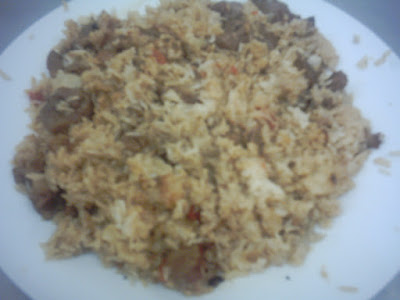
Makluba (مقلوبة) is a Palestinian dish from mutton, rice and vegetables, but as far as I know eaten also in the rest of Levant countries. In Arabic its name means nothing else but... "upside down", and Spaniards call it "arabic paella". Factually, there are many similarities between those two dishes: both contain similar ingredients (rice, vegetables, meat) cooked in one pan and were rather a poor dish, prepared from the resting pieces of meat and differrent vegetables. Today it is eaten usually on fridays and served to the guests to offer them respect and honour. But why is it called "upside-down"? After cooking, you should invert the content of the pan into a plate. If you are lucky, it will conserve the shape of the pan, but mine didn't. Anyway, taste counts ;)

(ps. the pics are of a bad quality; I am sorry for that, but you have to believe me, this dish tastes wonderful even for me, who never liked meat too much)

2 medium aubergines
2 big tomatoes
1 medium couliflower
1 big onion + 1 small onion
1/2 kg mutton shoulder*
1 1/2 cup basmati rice
cumin

1. Chop the small onion, fry until smelling and golden, add mutton (*I had about 3/4 kg mutton with bones and after cooking and throwing the bones away, there was 1/2 kg meat), fry a little bit and cook in 1/2-3/4 l water until soft

2. Peel and slice aubergines, sprinkle with salt and set aside until drops appear on its surface. Drain with a kitchen paper towel or with your hand, and fry

3. Divide cauliflower into chunks, cook for a very short time (about 5 minutes) in water with salt cumin


(beginning with tomatoes and moving as a clock needle: tomato slices, fried eggplants, mutton chunks, mutton broth, eggplants being drained, fried cauliflower chunks)

4. Wash rice, divide meat chunks from the broth

5. Prepare the pan: put some spoons of the fat that swims on the surface of your broth or spread some spoons oil, and cover the bottom of the top with thick slices of the big onion. This is actually my invention cause I like the taste of onions and here onions serve as a protection layer instead of backing sheet (some people put baking sheet on the bottom of the pan, some put tomatoes). The second layer are thick slices of tomato and the third are slices of fried eggplant. Then you put 1/2 amount of washed, drained rice. Next layer should be meat, then cauliflower, then the rest of the rice and then eggplant slices.


6. When ready with the layers, pour the broth over the dish. Broth should reach the top of the last layer, if it does't, add water. Taste the broth if there is enough salt. Cover the pan with aluminium sheet and simmer until rice is ready (usually about 1/2 hour). After that try to take the makluba away as it was a cake :) You can sprinkle it with toasted pine nuts and serve with yoghurt.
Saturday, 29 March 2008

Polish herring croquettes

Polish: śledź
Kashubian: stupka
Korean: 청어
Latvian: siļķes
Ukrainian: оселедець
Norwegian: sild
Georgian: ქაშაყი
Luxembourgian: hierk
Arabic: رنجة
Scottish Gaelic: sgadan

Herring has been a known staple food source since 3000 B.C. Here, in the Baltic sea region, herring is one of the most popular fishes. There are various methods of preparing it: raw, pickled, fried and even fermented... In Poland it is a must to eat herring during the lent before Easter and at the Christmas Eve Dinner, usually raw, cut into chunks with onion slices and oil. In my family we often eat this kind of herring salad for breakfast. Let me also propose a warm dinner dish: Polish herring croquettes, krokiety śledziowe.

see also: Portuguese codfish fritters

2 herring fillets, those without bones and heads, that were cured in salt (+ water + milk)
1/2 kg potatoes*
2 big onions
1 egg
1/2 cup breadcrumbs
pepper, dill
a bit of flour to sprinkle

1. Soak herrings overnight in water with a bit of milk to remove excessive salt

2. Cook potatoes (* if you want to obtain less herringy taste, take 1 kg of potatoes). Chop 1 onion and fry until golden brown

3. Using meat grinder, grind together soaked drained herings, cooked potatoes and the second onion

4. Combine the ground ingredients with breadcrumbs, chopped dill and lightly beaten egg. Add pepper to taste, you don't need to add salt cause herrings are already salty. Knead a bit.

5. Form croquettes, sprinkle with flour and fry. Serve with salads (tastes good with beetroot or raddish salad) and yoghurt with dill, parsley or chives


Friday, 7 March 2008

German tuna pasta

Polish: tuńczyk
Turkish: ton balığı
Catalan: tonyina
Latvian: tuncis
Rapanui: kahi
Lithuanian: paprastieji tunai
Arabic: تونة
Japanese: マグロ
Russian: тунец
Thai: ปลาทูน่า

People were fishing tunas even in the antiquity, while canned tuna was eaten since the beginning of XX century. Now, the canned version is eaten especially among students and diet-watchers. I learned this simple dish when I was studying in Germany. If yiu have not much time but wanna eat something tasty, prepare this: Thunfisch-Nudeln.

about 500 gr noodles (or less)
1 canned tuna (better without oil)
1 cup tomato puree (packed or made on your own from fresh tomatoes)
2 big onions, 2 garlic cloves
a handful parsley
salt, pepper
grated cheese

1. Cook noodles the way you always do, chop onions and parsley finely and grind garlic

2. Fry onions and garlic until golden, add tomato puree and stew some minutes, until tomato puree is thicker. Add drained tuna, stew a bit more. Season with salt, pepper and parsley to taste

3. Combine cooked noodles with tuna sauce and sprinkle with grated cheese before serving


Sunday, 13 January 2008

Romanian celery moussaka

Polish: seler
Turkish: kereviz
Sardinian: giùggiuru
Albanian: Selinoja
Hungarian: zeller
Slovak: okolíkatý
Romanian: ţelină
Zulu: useleri
Breton: ach
Chinese: 芹菜
Ukrainian: cелера
Flemish: selder
Vietnamese: cần tây
Arabic: كَرَفْس
Greek: Σέλινο
Quechua: kapin

Moussaka is a very popular dish in Balkans, Turkey and Romania. I don't know if celery moussaka is made in each of this regions but I found a Romanian recipe how to do it. I translated it with a help from UniLang friend, but of course changed it on my own way. Root celery is not one of the prettiest vegetables. I never liked its smell and always refused to taste a dish that contained even a bit of it. Now I know it is very healthy and I had to find a way to eat it and enjoy it. Here it goes: musaca de ţelină


200 gr turnip (about 3 medium turnips)
200 gr potatoes (about 2 big potatoes)
400 gr celery root (about 1 big root)
500 gr ground meat
2 eggs
3 onions
salt, pepper, nutmeg
1 cup sour cream
1 handful mint / parsley green
oil, butter

1. Cut vegetables into thin slices and fry each sort of them separately

2. Chop onions very fine, fry in oil. Add meat and chopped mint or parsley, salt and pepper to taste and fry.

3. Combine sour cream with 1 egg, scramble, season with nutmeg, salt and pepper

4. Grease a baking pn with butter. Cover the bottom of the pan with sliced fried celery slices.

5. Add egg to meat, mix well. Divide meat into 3 portions. Cover the celery layer with the first portion of meat.

6. 3. layer - fried potato slices; 4. layer - meat; 5. layer - tfried urnip slices; 6. layer - meat; 7. layer - cfried elery root slices; 8. layer - sour cream with scrambled egg.


7. Bake for about 30 minutes (or until the sour cream sauce is brownish) in the oven (250C)