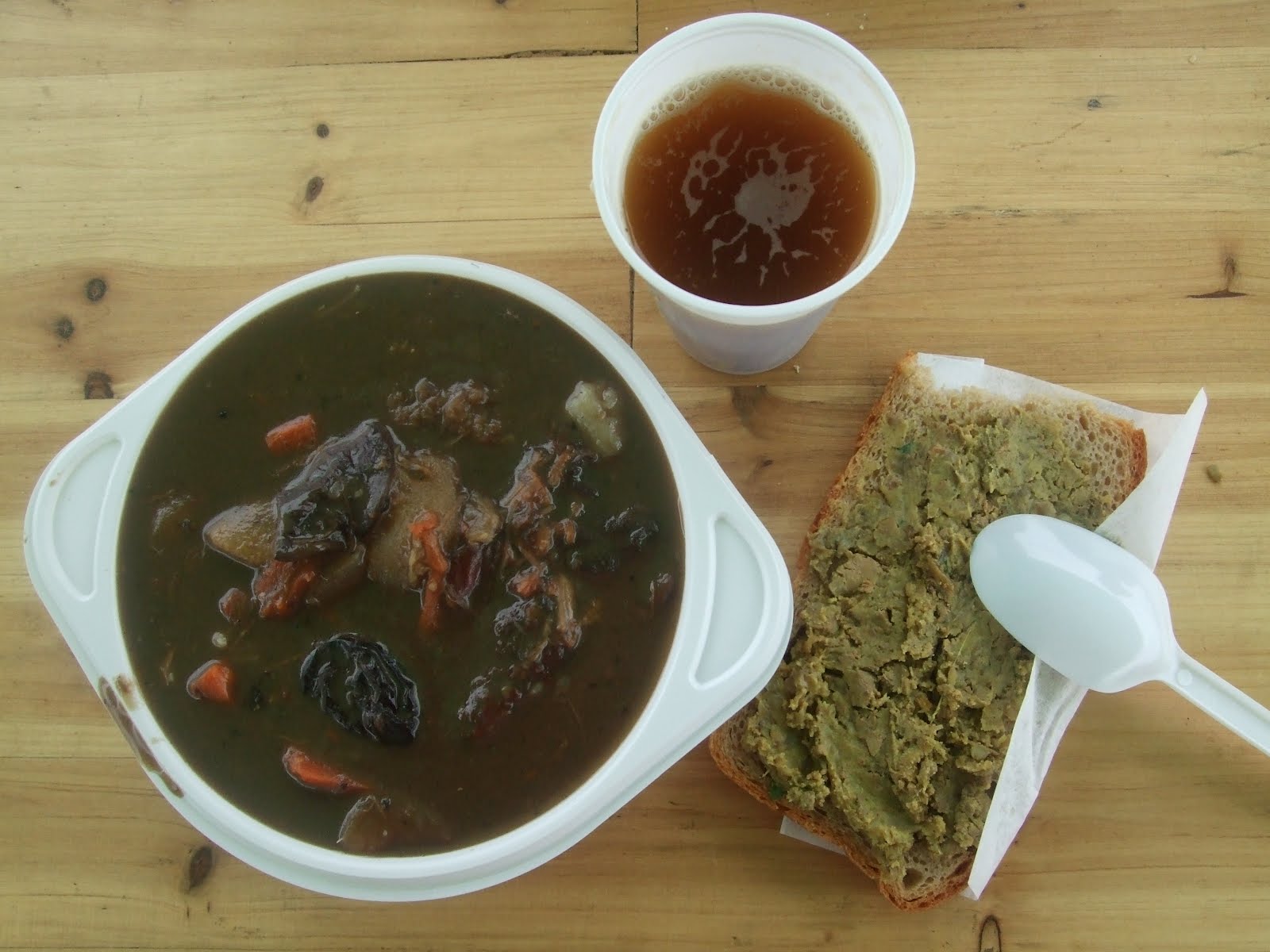
Culinary adventures in SIERPC skansen. Food from KURPIE region.
1. CZERNINA - a wonderful, tasteful and healthy soup for brave people. Its main ingredient is duck blood. Besides, it contains dry fruits (mainly dried pears and prunes), veggies and soft yummy potato dumplings and chunks of meat. It was a countryside typical soup, often prepared when there was a candidate to marry your daughter and he wasn't good enough (that is when this soup was symbolically served, to dump the guy). Have a look. After trying grilled blood in Spain I became crazy about blood dishes. I'll post abouti t separately.
2. SMAŻONKA, a kind of meat-onion casserole
3. MY DINNER - CZERNINA; PSIWO (homemade juniper beer) and a slice of homemade bread with liver pâté (they also served bread with lard and pickled cucumber)
4. OTHER BREADS
5. OTHER REGIONAL PRODUCTS: HOMEMADE CORDIALS, GRILL CAKES, wonderful dry SAUSAGES and FAFERNUCHY (honey, carrots and rye flour cakes)
Showing posts with label Cuisine: Polish. Show all posts
Saturday, 2 June 2012
Sunday, 8 April 2012
Polish spring spread
Polish: twaróg
English: curd
Bulgarian: Извара
Icelandic: ystingur
Georgian: ხაჭო
Tamil: தயிர்
Lithuanian: varškė
Spanish: requesón
Tatar: eremçek
Hungarian: túró
Curd cheese summer spread. Delicious!
English: curd
Bulgarian: Извара
Icelandic: ystingur
Georgian: ხაჭო
Tamil: தயிர்
Lithuanian: varškė
Spanish: requesón
Tatar: eremçek
Hungarian: túró
Curd cheese summer spread. Delicious!
Monday, 27 April 2009
Spring cold soups
Polish: Chłodnik
Belarusian: Хaлaднiк
Russian: Холодник
Ukrainian: Холодник
Lithuanian: Šaltibarščiai
Chłodnik means cold summer soup. It is eaten not only in Poland but also in other east-European countries. The most popular variant is made with beets and/or young beet leaves, kefir or soured milk and many differrent young fresh raw vegetables and vegetable greens. There are also non-beet variants, sour: with sorrel, tomato, kohlrabi or cucumber, and several fruit ones: especially with currants, strawberries (or wild strawberries), melon or cherry soup. And countless new creative versions. As a child, when my mum was pregnant with my brother, we had to eat meals at a dairy bar and we were eating chłodnik and crepes with curd cheese filling. My homemade chłodnik tastes much better :) The one made with beet leaves is called botwina. If you don't have baby beet fresh leaves, hopefully you could see, to inspire yourself, my attempts of making chłodnik when I was abroad and far away from beet leaves :)
for 3 portions:
2 bunches young beet leaves (each bunch contains 3-4 tiny beets)
2 medium beets
2 bunches radishes
1 bunch chives
1 bunch dill
1/2 lemon
3 cups kefir
1 cup yoghurt
3 eggs

1. Boil eggs for 10 minutes.
2. Cut beet leaves and stalks very finely. Peel tiny beets (those from leaves) and normal beets. Cut those bigger into fourths. Cook them in few (1 cup) water (some people take vegetable broth) until beets are soft. When ready, add freshly squeezed lemon juice.
3. Chop very finely other vegetables: chives, dill and radishes. Pour kefir and yoghurt into the bowl and add chopped vegetables.
4. Using a vegetable grater, grate cooked beets. Add beets, beet leaves and the water in which they were cooked, to the kefir.
5. Season with salt, pepper, lemon juice or apple vinegar and maybe also with garlic. Serve with egg halves (and probably some chopped parsley green)

and here comes another recipe, less popular but also tasty: sorrel chłodnik with whey(chłodnik szczawiowy na serwatce)
250 gr sorrel leaves
3 cups whey (see here how to make whey)
1 cup sour cream
3 tablespoons flour
3 eggs
1 tablespoon butter
dill
1. Bring whey to boil. Whisk cream (of room temperature; not taken directly from the fridge!) with flour until there are no clumps and add to warm whey. Stir and let boil again. Set aside.
2. Chop sorrel finely and stew it with butter and probably very few water for about 10 minutes. Set aside.
3. Add sorrel to cooled whey, salt to taste and sprinkle with dill. Serve with potatoes (serve warm boiled potato chunks on a separate plate or pour cold soup over warm potatoes in a bowl). You can also add boiled egg halves.
Belarusian: Хaлaднiк
Russian: Холодник
Ukrainian: Холодник
Lithuanian: Šaltibarščiai
Chłodnik means cold summer soup. It is eaten not only in Poland but also in other east-European countries. The most popular variant is made with beets and/or young beet leaves, kefir or soured milk and many differrent young fresh raw vegetables and vegetable greens. There are also non-beet variants, sour: with sorrel, tomato, kohlrabi or cucumber, and several fruit ones: especially with currants, strawberries (or wild strawberries), melon or cherry soup. And countless new creative versions. As a child, when my mum was pregnant with my brother, we had to eat meals at a dairy bar and we were eating chłodnik and crepes with curd cheese filling. My homemade chłodnik tastes much better :) The one made with beet leaves is called botwina. If you don't have baby beet fresh leaves, hopefully you could see, to inspire yourself, my attempts of making chłodnik when I was abroad and far away from beet leaves :)
for 3 portions:
2 bunches young beet leaves (each bunch contains 3-4 tiny beets)
2 medium beets
2 bunches radishes
1 bunch chives
1 bunch dill
1/2 lemon
3 cups kefir
1 cup yoghurt
3 eggs

1. Boil eggs for 10 minutes.
2. Cut beet leaves and stalks very finely. Peel tiny beets (those from leaves) and normal beets. Cut those bigger into fourths. Cook them in few (1 cup) water (some people take vegetable broth) until beets are soft. When ready, add freshly squeezed lemon juice.
3. Chop very finely other vegetables: chives, dill and radishes. Pour kefir and yoghurt into the bowl and add chopped vegetables.
4. Using a vegetable grater, grate cooked beets. Add beets, beet leaves and the water in which they were cooked, to the kefir.
5. Season with salt, pepper, lemon juice or apple vinegar and maybe also with garlic. Serve with egg halves (and probably some chopped parsley green)

and here comes another recipe, less popular but also tasty: sorrel chłodnik with whey(chłodnik szczawiowy na serwatce)
250 gr sorrel leaves
3 cups whey (see here how to make whey)
1 cup sour cream
3 tablespoons flour
3 eggs
1 tablespoon butter
dill
1. Bring whey to boil. Whisk cream (of room temperature; not taken directly from the fridge!) with flour until there are no clumps and add to warm whey. Stir and let boil again. Set aside.
2. Chop sorrel finely and stew it with butter and probably very few water for about 10 minutes. Set aside.
3. Add sorrel to cooled whey, salt to taste and sprinkle with dill. Serve with potatoes (serve warm boiled potato chunks on a separate plate or pour cold soup over warm potatoes in a bowl). You can also add boiled egg halves.
Friday, 17 April 2009
Polish Easter
Polish: Wielkanoc
Kashubian: Jastrë
English: Easter
Albanian: Pashkët
Mokshan: Очижи
Lithuanian: Velykos
Georgian: აღდგომა
Ossetian: Куадзæн
Swabian: Auschdra
Croatian: Uskrs
Easter breakfast is the most important thing about celebrating Easter in Poland. Everyone wakes up very early and participates at Rezurekcja (6 o'clock a.m. Holy Mass); the naive one who plans to be lazy and sleep longer rather won't be able to, cause at this time you will hear everywhere clangor of special instruments, petards, bells and so on. After that, at least in my family, men prepare and decorate breakfast table while women bake white sausage, season żurek and decorate meals. However, almost everything is already done. Pisanki are painted, żur is already sour, babka is waiting to be served... A culinary must are: żurek, sour rye soup (eaten with chunks of white sausage and boiled eggs, often served in cored little breads), baked white sausage, eggs and babka with mazurek, two kinds of cakes, a flat and a tall one. Often people serve pascha, curd cheese dessert, and chałka, hallah bread. There is actually no other meal this day, people just sit together, start eating breakfast, talk, spend lazy time, heat resting żurek and kiełbasa for dinner and leave the table only to cut some more bread or to boil new portion of tea.
see also: pictures of my family's 2008 Easter breakfast dishes

This year my family's Easter menu was:
* żurek - sour rye soup (for more details, visit the previous post). Sometimes can be replaced by horseradish soup, sometimes people cook a fusion of both: a delicious horseradish żur. The main thing is a sour taste!)
* pieczona biała kiełbasa - baked white sausage
* rolada szpinakowa - spinach & smoked salmon & horseradish cheese roll
* chicken-vegetable (pea, bean, corn, radish etc.) salad
* ser jajeczny - egg cheese (eggs cooked with milk until curdles; looks like cheese, tastes like eggs, traditionally eaten with horseradish sauce)
* jajka - hard-boiled eggs (plain or marinated in beetroot juice) with mayonnaise
* homemade bread
* chałka - hallah
* puff pastry poppy seed pigtails
* babka (egg-yeast tall traditional cake, this year with coffee flavour and coffee icing)
* mazurek (the flat cake; this year with Easter rabbit)
* cooked (yes! not baked! just cooked!) cheesecake with poppy seed-coconut roll cake
* pear-jelly-biscuit cake
* homemade butter
* ćwikła (horseradish with beets), horseradish sauce, red and black kaviar
* sos tatarski - tartar sauce (mayonnaise, sour cream, horseradish, chopped pickled sour cucumbers, capers, champignons, hard-boiled eggs, chives, lemon juice)
* slices of fresh vegetables, homemade pickled mushrooms
* homemade (preserved) cherry juice (kompot wisniowy)
bread, tartar sauce, eggs and egg cheese:

beet-dyed-eggs and egg cheese:

mayonnaise eggs, homemade butter, spinach roll:

spinach roll:

chicken-vegetable salad with duck-egg on the top, sauces and kaviar:

mushrooms and garden cress:

chałka:


mazurek:

pear-jelly-biscuit cake:

raspberry pascha:

babka:

cooked cheesecake hidden in poppy seed-coconut roll:

An important ingredient of eastern breakfast is a plate full of differrent sausages, just like these
Traditional Easter decoration are: garden cress and oat grass, box twigs, willow twigs with catkins, daffodils, myrtle, little lambs (symbol of Jesus Christ) and obviously pisanki, which are eggs painted, dyed, scratched, decorated with bulrush pith or painted with melted wax
Kashubian: Jastrë
English: Easter
Albanian: Pashkët
Mokshan: Очижи
Lithuanian: Velykos
Georgian: აღდგომა
Ossetian: Куадзæн
Swabian: Auschdra
Croatian: Uskrs
Easter breakfast is the most important thing about celebrating Easter in Poland. Everyone wakes up very early and participates at Rezurekcja (6 o'clock a.m. Holy Mass); the naive one who plans to be lazy and sleep longer rather won't be able to, cause at this time you will hear everywhere clangor of special instruments, petards, bells and so on. After that, at least in my family, men prepare and decorate breakfast table while women bake white sausage, season żurek and decorate meals. However, almost everything is already done. Pisanki are painted, żur is already sour, babka is waiting to be served... A culinary must are: żurek, sour rye soup (eaten with chunks of white sausage and boiled eggs, often served in cored little breads), baked white sausage, eggs and babka with mazurek, two kinds of cakes, a flat and a tall one. Often people serve pascha, curd cheese dessert, and chałka, hallah bread. There is actually no other meal this day, people just sit together, start eating breakfast, talk, spend lazy time, heat resting żurek and kiełbasa for dinner and leave the table only to cut some more bread or to boil new portion of tea.
see also: pictures of my family's 2008 Easter breakfast dishes
This year my family's Easter menu was:
* żurek - sour rye soup (for more details, visit the previous post). Sometimes can be replaced by horseradish soup, sometimes people cook a fusion of both: a delicious horseradish żur. The main thing is a sour taste!)
* pieczona biała kiełbasa - baked white sausage
* rolada szpinakowa - spinach & smoked salmon & horseradish cheese roll
* chicken-vegetable (pea, bean, corn, radish etc.) salad
* ser jajeczny - egg cheese (eggs cooked with milk until curdles; looks like cheese, tastes like eggs, traditionally eaten with horseradish sauce)
* jajka - hard-boiled eggs (plain or marinated in beetroot juice) with mayonnaise
* homemade bread
* chałka - hallah
* puff pastry poppy seed pigtails
* babka (egg-yeast tall traditional cake, this year with coffee flavour and coffee icing)
* mazurek (the flat cake; this year with Easter rabbit)
* cooked (yes! not baked! just cooked!) cheesecake with poppy seed-coconut roll cake
* pear-jelly-biscuit cake
* homemade butter
* ćwikła (horseradish with beets), horseradish sauce, red and black kaviar
* sos tatarski - tartar sauce (mayonnaise, sour cream, horseradish, chopped pickled sour cucumbers, capers, champignons, hard-boiled eggs, chives, lemon juice)
* slices of fresh vegetables, homemade pickled mushrooms
* homemade (preserved) cherry juice (kompot wisniowy)
bread, tartar sauce, eggs and egg cheese:
beet-dyed-eggs and egg cheese:
mayonnaise eggs, homemade butter, spinach roll:
spinach roll:
chicken-vegetable salad with duck-egg on the top, sauces and kaviar:
mushrooms and garden cress:
chałka:
mazurek:
pear-jelly-biscuit cake:
raspberry pascha:
babka:
cooked cheesecake hidden in poppy seed-coconut roll:
An important ingredient of eastern breakfast is a plate full of differrent sausages, just like these
Traditional Easter decoration are: garden cress and oat grass, box twigs, willow twigs with catkins, daffodils, myrtle, little lambs (symbol of Jesus Christ) and obviously pisanki, which are eggs painted, dyed, scratched, decorated with bulrush pith or painted with melted wax
Thursday, 9 April 2009
Polish whey borscht
Polish: serwatka
French: petit-lait
Luxembourgish: Wässeg
Lithuanian: išrūgos
Hindi: छाछ
Albanian: hirrë
Xhosa: ingqaka
Spanish: suero
Slovakian: sirotka
Arabic: شرش اللبن
Whey soup, again! This time a very winter-to-spring-turn recipe. In Poland, beetroot is often eaten during the wintertime, while one of the first culinary appearances of spring is rhubarb chard (botwina / boćwina). Chard is often used in cold or warm spring/summer soups, like chłodnik. If you already have chard, you can prepare a great borscht (sour beet soup) with whey. Actually, beet-whey borscht (podhalański barszcz na serwatce) belongs to Polish Tatra cuisine. It is cheap and easy to make. I decided to modify this tasty recipe a bit, so I added chard.
How to make a whey at home? Check here
see also: Polish horseradish-whey soup
see also: Polish millet-whey soup
see also: Moldovan whey soup
(3 portions)
4 medium beets
4 medium potatoes
1/2 cup yoghurt / sour cream
2 cups whey
seasoning: salt, sugar, apple vinegar
(+ 1 bunch rhubarb chard, 1 onion)*
1. Cook beets and potatoes separately. Peel and dice. (chop onion and chard, fry in oil about 5 minutes)*
2. In a saucepan, put diced beets (and chopped fried chard with onion)*. Add 2 cups water and bring to boil. Add whey and season (with salt, sugar, vinegar and probably also garlic) to taste. Turn off the heat, add sour cream (yoghurt) and stir well. Don't bring to boil anymore, just heat if needed.
3. Put some diced potatoes into an eating bowl and add soup. You can also serve potatoes separately, on a small plate.
French: petit-lait
Luxembourgish: Wässeg
Lithuanian: išrūgos
Hindi: छाछ
Albanian: hirrë
Xhosa: ingqaka
Spanish: suero
Slovakian: sirotka
Arabic: شرش اللبن
Whey soup, again! This time a very winter-to-spring-turn recipe. In Poland, beetroot is often eaten during the wintertime, while one of the first culinary appearances of spring is rhubarb chard (botwina / boćwina). Chard is often used in cold or warm spring/summer soups, like chłodnik. If you already have chard, you can prepare a great borscht (sour beet soup) with whey. Actually, beet-whey borscht (podhalański barszcz na serwatce) belongs to Polish Tatra cuisine. It is cheap and easy to make. I decided to modify this tasty recipe a bit, so I added chard.
How to make a whey at home? Check here
see also: Polish horseradish-whey soup
see also: Polish millet-whey soup
see also: Moldovan whey soup
(3 portions)
4 medium beets
4 medium potatoes
1/2 cup yoghurt / sour cream
2 cups whey
seasoning: salt, sugar, apple vinegar
(+ 1 bunch rhubarb chard, 1 onion)*
1. Cook beets and potatoes separately. Peel and dice. (chop onion and chard, fry in oil about 5 minutes)*
2. In a saucepan, put diced beets (and chopped fried chard with onion)*. Add 2 cups water and bring to boil. Add whey and season (with salt, sugar, vinegar and probably also garlic) to taste. Turn off the heat, add sour cream (yoghurt) and stir well. Don't bring to boil anymore, just heat if needed.
3. Put some diced potatoes into an eating bowl and add soup. You can also serve potatoes separately, on a small plate.
Sunday, 5 April 2009
Polish carrot-poppy roll cake
Polish: marchew
Gujarati: ગાજર
Hindi: गाजर
Marathi: गाजर
Punjabi: ਗਾਜਰ
Sanskrit: गृञ्जनकम्
Tamil: காரட்
Telugu: గాజర గడ్డ
Urdu: گاجر
Carrots, again :) Can there be something more Polish than poppy seed, roll cake and carrots? Well yes, mead, buckwheat, beetroots... and so on... Oh well... Anyway, I guess lots of people consider poppy seed a typical central and eastern European ingredient and they are just right. There are millions of poppy seed recipes (cakes, pies, buns, dumplings and so on). My today's recipe is called marchwiak. Well, marchew means just carrot in Polish. Marchwiak is a roll cake with carrot-poppy filling from Lubelszczyzna, a beautiful region of eastern Poland, with Lublin as its capital city. Marchwiaki were traditionally baked for All Saint's Day. A very similar yeast roll cake, but with other filling (apple-poppy) was baked by my grandmum (she comes from Podlasie, a region next to Lubelszczyzna; to see more pictures of this beautiful region of Poland, visit a stunning blog with awesome pictures from Podlasie. More pictres for example here. Pictures from Lubelszczyzna can be found here)
500 gr flour
50 gr fresh yeast
1/2 cup milk
1/2 cup water
1/2 cup sugar
2 egg yolks
1 egg white
1 egg
a pinch of salt
1/4 cup lard (melted)
3/4 cup grated carrot*
1 handful poppy seeds
(optionally add 1 tablespoon grated orange or lemon zest - it is not included to the traditional recipe, but it will improve the taste deffinitely)
icing: icing sugar + lemon juice
few poppy seeds more to sprinkle
1. Heat the milk (but don't boil it), add yeast, sugar and 1 tablespoon flour. Set in a warm place and let it grow.
2. Sieve flour, add yeast, water, whisked 2 yolks with 1 egg, salt and melted lard (everything in room temperature, as it always should be when baking yeast cakes!) and knead the dough. When everything combines well and you obtained elastic dough, form a ball and let it grow in a bowl. When it doubles its surface, knead again. I did this point in a bread machine (kneading and growing program)
3. Sprinkle your workplace with some flour. Now decide if you want 2 rolls or 1 roll and six lovely buns. In next point I will first continue about how to make roll cake.
4. Roll the dough (actually, roll only a half of your dough; the second half is to make a second roll or sweet breakfast buns - or just reduce the proportions, which I never made, cause I always prepare a roll cake and breakfast buns :P)
5. When your dough is rolled into 0,5 - 1 cm thick, smear it with egg white. I do it always in Christmas poppy seed or nut roll cakes to avoid gaps between dough and filling. Now, sprinkle it with grated carrot and a handful of poppy seed (and optionally lemon or orange zest, which is highly recommended and, if you wish the roll to be sweeter, sprinkle with 1 tablespoon sugar)
* 3/4 cup is to fill 1 roll cake. prepare also another 3/4 cup to fill the second roll if you decide to bake 2 rolls

6. Now slowly fold the dough. Put it gently on a sheet of baking paper. Sprinkle with the resting few poppy seeds. Bake in 180C oven about 30 minutes or until golden brown.
7. Prepare the icing my mixing lemon juice with icing sugar and pour it on already cooled roll cake.


8. About sweet breakfast buns - after kneading-growing process, just form lovely round-shaped buns (I make six) and let them grow for a while. Smear with egg white and sprinkle with poppy seeds and bake until golden brown. I don't have any picture of them, my family was too fast :(
Gujarati: ગાજર
Hindi: गाजर
Marathi: गाजर
Punjabi: ਗਾਜਰ
Sanskrit: गृञ्जनकम्
Tamil: காரட்
Telugu: గాజర గడ్డ
Urdu: گاجر
Carrots, again :) Can there be something more Polish than poppy seed, roll cake and carrots? Well yes, mead, buckwheat, beetroots... and so on... Oh well... Anyway, I guess lots of people consider poppy seed a typical central and eastern European ingredient and they are just right. There are millions of poppy seed recipes (cakes, pies, buns, dumplings and so on). My today's recipe is called marchwiak. Well, marchew means just carrot in Polish. Marchwiak is a roll cake with carrot-poppy filling from Lubelszczyzna, a beautiful region of eastern Poland, with Lublin as its capital city. Marchwiaki were traditionally baked for All Saint's Day. A very similar yeast roll cake, but with other filling (apple-poppy) was baked by my grandmum (she comes from Podlasie, a region next to Lubelszczyzna; to see more pictures of this beautiful region of Poland, visit a stunning blog with awesome pictures from Podlasie. More pictres for example here. Pictures from Lubelszczyzna can be found here)
500 gr flour
50 gr fresh yeast
1/2 cup milk
1/2 cup water
1/2 cup sugar
2 egg yolks
1 egg white
1 egg
a pinch of salt
1/4 cup lard (melted)
3/4 cup grated carrot*
1 handful poppy seeds
(optionally add 1 tablespoon grated orange or lemon zest - it is not included to the traditional recipe, but it will improve the taste deffinitely)
icing: icing sugar + lemon juice
few poppy seeds more to sprinkle
1. Heat the milk (but don't boil it), add yeast, sugar and 1 tablespoon flour. Set in a warm place and let it grow.
2. Sieve flour, add yeast, water, whisked 2 yolks with 1 egg, salt and melted lard (everything in room temperature, as it always should be when baking yeast cakes!) and knead the dough. When everything combines well and you obtained elastic dough, form a ball and let it grow in a bowl. When it doubles its surface, knead again. I did this point in a bread machine (kneading and growing program)
3. Sprinkle your workplace with some flour. Now decide if you want 2 rolls or 1 roll and six lovely buns. In next point I will first continue about how to make roll cake.
4. Roll the dough (actually, roll only a half of your dough; the second half is to make a second roll or sweet breakfast buns - or just reduce the proportions, which I never made, cause I always prepare a roll cake and breakfast buns :P)
5. When your dough is rolled into 0,5 - 1 cm thick, smear it with egg white. I do it always in Christmas poppy seed or nut roll cakes to avoid gaps between dough and filling. Now, sprinkle it with grated carrot and a handful of poppy seed (and optionally lemon or orange zest, which is highly recommended and, if you wish the roll to be sweeter, sprinkle with 1 tablespoon sugar)
* 3/4 cup is to fill 1 roll cake. prepare also another 3/4 cup to fill the second roll if you decide to bake 2 rolls

6. Now slowly fold the dough. Put it gently on a sheet of baking paper. Sprinkle with the resting few poppy seeds. Bake in 180C oven about 30 minutes or until golden brown.
7. Prepare the icing my mixing lemon juice with icing sugar and pour it on already cooled roll cake.


8. About sweet breakfast buns - after kneading-growing process, just form lovely round-shaped buns (I make six) and let them grow for a while. Smear with egg white and sprinkle with poppy seeds and bake until golden brown. I don't have any picture of them, my family was too fast :(
Polish soda breads
Polish: soda (do pieczenia)
German: Speisesoda
Croatian: soda bikarbona
Spanish: bicarbonato de sodio
Bulgarian: сода за хляб
Ukrainian: Гідрокарбонат натрію
French: bicarbonate alimentaire
Proziaki , sisters of Mediterranean and Middle Eastern pita bread / khubs, are flat soda breads, baked on the top plate of warm stove. Commonly eaten in Polish Carpathians but not only; my mum, who comes from central-eastern Poland, know them from her childhood, but under a simple name placki (pancakes). If you can use a real stove, you are lucky. If not, you can still bake proziaki, just take the thickest frying pan you have and bake them dry, without any oil. I actually regret that I prepared them cause now my mum is molesting me each morning to bake some proziaki for breakfast... We cut them just like bread rolls, smear with butter and eat with bittercress and cucumber
500 gr flour
1 cup sour milk (Polish: zsiadłe mleko; optionally: sour cream or thick yoghurt)
1 teaspoon salt
1 teaspoon sugar
1 teaspoon bread soda (sodium bicarbonate)
(some people experiment by adding 1 egg or few curd fresh cheese)
1. Sieve all loose ingredients into a bowl. Spoon by spoon, add sour milk and kned in your hands. You should obtain thick but elastic dough.
2. Sprinkle your workplace with flour. Roll the dough until 0,5 cm thick and cut into squares with a knife or into circles with a big cookie cutter or glass.
(1st pic: proziaki before and after baking)


German: Speisesoda
Croatian: soda bikarbona
Spanish: bicarbonato de sodio
Bulgarian: сода за хляб
Ukrainian: Гідрокарбонат натрію
French: bicarbonate alimentaire
Proziaki , sisters of Mediterranean and Middle Eastern pita bread / khubs, are flat soda breads, baked on the top plate of warm stove. Commonly eaten in Polish Carpathians but not only; my mum, who comes from central-eastern Poland, know them from her childhood, but under a simple name placki (pancakes). If you can use a real stove, you are lucky. If not, you can still bake proziaki, just take the thickest frying pan you have and bake them dry, without any oil. I actually regret that I prepared them cause now my mum is molesting me each morning to bake some proziaki for breakfast... We cut them just like bread rolls, smear with butter and eat with bittercress and cucumber
500 gr flour
1 cup sour milk (Polish: zsiadłe mleko; optionally: sour cream or thick yoghurt)
1 teaspoon salt
1 teaspoon sugar
1 teaspoon bread soda (sodium bicarbonate)
(some people experiment by adding 1 egg or few curd fresh cheese)
1. Sieve all loose ingredients into a bowl. Spoon by spoon, add sour milk and kned in your hands. You should obtain thick but elastic dough.
2. Sprinkle your workplace with flour. Roll the dough until 0,5 cm thick and cut into squares with a knife or into circles with a big cookie cutter or glass.
(1st pic: proziaki before and after baking)


Saturday, 4 April 2009
Polish whey-millet soup
Polish: serwatka
Pashto: چکه
English: whey
vietnamese: nước sữa
German: Molke
Punjabi: ਛਾੰਛ
Suahili: gururu
Icelandic: mysa
Estonian: vadak
Sestwana: mokaro
Polish (and East European) soups with groats (usually barley, but also buckwheat or millet) are called krupnik. This word comes from old-Polish word krupy, which means just groats. Krupnik contains also lots of differrent vegetables and often dried mushrooms. The recipe I am going to show you now has no vegetables besides potatoes, but tastes nicely sour because of whey. This recipe comes from Miechów, a town in southern Poland. Ladies and gentlemen, Polish whey-millet soup, miechowski krupnik na serwatce!
see also: Polish horseradish-whey soup
see also: Moldovan whey soup
5 cups whey
200 gr millet
500 gr potatoes
1 bunch dill
1 teaspoon lemon juice
1/2 cup sour cream
salt, sugar
1. Wash millet in cold water. Plunge into boiling water, after few minutes set on a colander and place under cold running water. Now you can simply cook millet in 2 cups water or broth for 15 minutes (don't overcook, just observe the grains!)
2. Separately, cook unpeeled potatoes.
3. Pour whey into a saucepan, add chopped dill, cooked millet, cooked, peeled and diced potatoes, lemon juice and a pinch of salt and sugar. Bring to boil.
4. Turn off the heat. Pour sour cream to a bowl, add 1 cup of whey soup and stir well. Add it to the pan with the soup and stir. Don't boil anymore.
Pashto: چکه
English: whey
vietnamese: nước sữa
German: Molke
Punjabi: ਛਾੰਛ
Suahili: gururu
Icelandic: mysa
Estonian: vadak
Sestwana: mokaro
Polish (and East European) soups with groats (usually barley, but also buckwheat or millet) are called krupnik. This word comes from old-Polish word krupy, which means just groats. Krupnik contains also lots of differrent vegetables and often dried mushrooms. The recipe I am going to show you now has no vegetables besides potatoes, but tastes nicely sour because of whey. This recipe comes from Miechów, a town in southern Poland. Ladies and gentlemen, Polish whey-millet soup, miechowski krupnik na serwatce!
see also: Polish horseradish-whey soup
see also: Moldovan whey soup
5 cups whey
200 gr millet
500 gr potatoes
1 bunch dill
1 teaspoon lemon juice
1/2 cup sour cream
salt, sugar
1. Wash millet in cold water. Plunge into boiling water, after few minutes set on a colander and place under cold running water. Now you can simply cook millet in 2 cups water or broth for 15 minutes (don't overcook, just observe the grains!)
2. Separately, cook unpeeled potatoes.
3. Pour whey into a saucepan, add chopped dill, cooked millet, cooked, peeled and diced potatoes, lemon juice and a pinch of salt and sugar. Bring to boil.
4. Turn off the heat. Pour sour cream to a bowl, add 1 cup of whey soup and stir well. Add it to the pan with the soup and stir. Don't boil anymore.
Sunday, 29 March 2009
Waffle cake tutorial + vanilla filling
Wafer cake (torcik waflowy, sometimes called pishinger) is very popular in Poland, but also in Russia and probably other east-european countries. Simply wafer sheets filled with differrent kind of creams. Thanks to Feedjit I know that many internauts visit my blog in search of filled wafer cake recipe, and I know that some of you make this cake in a wrong way. That is why I decided to give you a kind of tutorial, to explain you step by step how to prepare this delicious, simply no-bake cake.
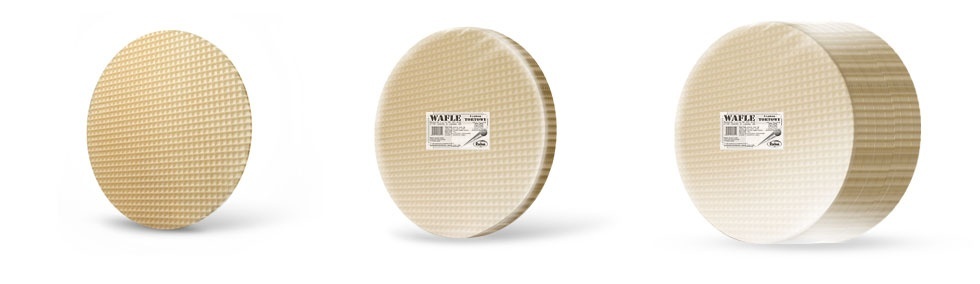
First of all, you need big wafer sheets (outside Poland, available in Polish or Russian groceries) -> like these or these. There are even heart-shaped waffles :) Don't you believe me? Go and see what a Polish blogger made with her waffles in a free time :)
Secondly, you have to choose the filling. There are plenty of differrent fillings, for example:
- toffee filling (or more extravagant: toffee with cookies)
- fruity filling
- helva filling
- peanut cream filling*
- eggnog cream filling
- honey cream filling
- lekvar-choco filling
- cacao cream filling
- vanilla cream filling
The most popular fillings in Poland are toffee filling (cook a can of condensed milk for 3 hours in a pot with water, open the can, beat the toffee that you just obtained with some soft butter) or powdered milk-based cacao cream. I promise to show you in the future more differrent filling recipes.
*this filling is delicious but you need to double or triple this recipe to be able to fill 1 pack of wafer sheets
Third thing is decoration. You can just leave undecorated filled wafers and cut them into diamonds, or spread with chocolate glaze and sprinkle with chopped nuts (other ideas are more than welcome). Torcik waflowy is often made for Easter and decorated just like mazurek, a famous Polish Easter cake. Just decorate waffle cake like mazurek or cut it into a shape of egg and decorate - like here or here.
Ok. If you already have made your plans, let's start!
1. Prepare enough cream (better more than less). At least 2 cups of cream for 1 pack of waffles.
2. Smear cream on waffles, when it is still warm! Don't skimp it, remember to cover the whole waffle with about 5mm of filling! Start from the inside.

Remember, begin with a wafer sheet and end with a wafer sheet - cream should stay inside! Cause...
3. ...cause when you are done with smearing waffles, now you have to wrap your cake into a baking paper or culinary aluminium paper. Leave it in a cool place and load it by putting a heavy big enciclopedia on the top of the wrapped cake! If not, soft (by a warm cream) waffle sheets will probaly deform. By loading our cake, it stays well-shaped and the filling glues wafer sheets (but remember, just like I said before, each sheet needs a lot of filling!) the best would be to leave the cake overnight but if not, than at least 2 hours. After that time, sheets will stay soft and the filling won't run down by cutting the cake!
4. Only now you can cut your cake into diamonds (or any other portions) and put on a plate or... decorate it and serve without cutting.
Now the fifth filling option (after toffe, fruity, helva and peanut filling), the one my mum got from my aunt Basia, who makes the best cakes of the world: sweet and delicious milky vanilla filling
1 cup milk
1 cup sugar
250 gr margarine (important: no butter!)
3 cups powdered milk*
few drops vanilla flavouring
(optionally: 1/2 teaspoon cocoa. If you add 3-4 tablespoons pure cocoa powder, you'll obtain vanilla-cocoa cream)
*If your cream is thick enough, you can add a bit less powdered milk. Or, take 2 cups powdered milk and 1 cup ground walnuts/almods/coconut flakes!
1. In a saucepan, bring to boil milk, margarine and sugar. Pour into a bowl and gradually add small amounts of powdered milk (nuts, cocoa) and flavouring and stir well all the time (make no clumps!). Smear waffles... well... and follow the tutorial instructions above (from point 2) :)
2. Optionally, melt 100 gr milk chocolate with 25 gr copha (coconut fat), decorate the cake, sprinkle with chopped nuts, decorate with nut halves, candies, coconut flakes or anything you like! It's really delicious!

First of all, you need big wafer sheets (outside Poland, available in Polish or Russian groceries) -> like these or these. There are even heart-shaped waffles :) Don't you believe me? Go and see what a Polish blogger made with her waffles in a free time :)
Secondly, you have to choose the filling. There are plenty of differrent fillings, for example:
- toffee filling (or more extravagant: toffee with cookies)
- fruity filling
- helva filling
- peanut cream filling*
- eggnog cream filling
- honey cream filling
- lekvar-choco filling
- cacao cream filling
- vanilla cream filling
The most popular fillings in Poland are toffee filling (cook a can of condensed milk for 3 hours in a pot with water, open the can, beat the toffee that you just obtained with some soft butter) or powdered milk-based cacao cream. I promise to show you in the future more differrent filling recipes.
*this filling is delicious but you need to double or triple this recipe to be able to fill 1 pack of wafer sheets
Third thing is decoration. You can just leave undecorated filled wafers and cut them into diamonds, or spread with chocolate glaze and sprinkle with chopped nuts (other ideas are more than welcome). Torcik waflowy is often made for Easter and decorated just like mazurek, a famous Polish Easter cake. Just decorate waffle cake like mazurek or cut it into a shape of egg and decorate - like here or here.
Ok. If you already have made your plans, let's start!
1. Prepare enough cream (better more than less). At least 2 cups of cream for 1 pack of waffles.
2. Smear cream on waffles, when it is still warm! Don't skimp it, remember to cover the whole waffle with about 5mm of filling! Start from the inside.

Remember, begin with a wafer sheet and end with a wafer sheet - cream should stay inside! Cause...
3. ...cause when you are done with smearing waffles, now you have to wrap your cake into a baking paper or culinary aluminium paper. Leave it in a cool place and load it by putting a heavy big enciclopedia on the top of the wrapped cake! If not, soft (by a warm cream) waffle sheets will probaly deform. By loading our cake, it stays well-shaped and the filling glues wafer sheets (but remember, just like I said before, each sheet needs a lot of filling!) the best would be to leave the cake overnight but if not, than at least 2 hours. After that time, sheets will stay soft and the filling won't run down by cutting the cake!
4. Only now you can cut your cake into diamonds (or any other portions) and put on a plate or... decorate it and serve without cutting.
Now the fifth filling option (after toffe, fruity, helva and peanut filling), the one my mum got from my aunt Basia, who makes the best cakes of the world: sweet and delicious milky vanilla filling
1 cup milk
1 cup sugar
250 gr margarine (important: no butter!)
3 cups powdered milk*
few drops vanilla flavouring
(optionally: 1/2 teaspoon cocoa. If you add 3-4 tablespoons pure cocoa powder, you'll obtain vanilla-cocoa cream)
*If your cream is thick enough, you can add a bit less powdered milk. Or, take 2 cups powdered milk and 1 cup ground walnuts/almods/coconut flakes!
1. In a saucepan, bring to boil milk, margarine and sugar. Pour into a bowl and gradually add small amounts of powdered milk (nuts, cocoa) and flavouring and stir well all the time (make no clumps!). Smear waffles... well... and follow the tutorial instructions above (from point 2) :)
2. Optionally, melt 100 gr milk chocolate with 25 gr copha (coconut fat), decorate the cake, sprinkle with chopped nuts, decorate with nut halves, candies, coconut flakes or anything you like! It's really delicious!

Tuesday, 24 March 2009
Polish dill soup
Polish: koperek
Berber: aslili
Dhivehi: ދަމުއި
Manx: lus veein
Greek: άνηθο
Spanish: eneldo
Japanese: イノンド
German: Dill
Persian: شوید
Basque: ezamihilu
Dill was the most favourite seasoning of a Polish medieval poet, Mikołaj Rej. I guess Mikołaj never ate young boiled potatoes with butter and dill, accompaigned by a glass of fresh kefir or soured milk, a popular summer Polish meal, cause in medieval Poland potatoes were still unknown. But I guess he could know the taste of herring in dill, soured cucumbers pickled with dill, fish in dill sauce or dill soup (maybe a bit different than mine). Polish zupa koperkowa, dill soup, is really a very tasty dish. And an extremely easy one, you will be done in 10 minutes!!! Eat dill and you'll be strong, dill was stimulating Roman gladiators and strengthing Egyptian pyramid constructors :)
2 buns dill (from 1/3 to 1/2 cup chopped dill)
1 l vegetable or chicken stock
1 carrot
1 onion
100 gr processed cheese (melted cheese - Polish serek topiony, German Schmelzkäse) or thick sour cream (but it tastes better with cheese!)
tiny noodles (like those , those or those or any other small noodles. Eventually, take 1/2 cup rice and cook it in the stock just like it would be noodles)
1. Chop dill finely and slightly fry in oil. Grate carrot and chop onion and fry them, too. Add them to the stock (homemade or from cube). Add noodles. Cook until noodles are done.
2. Take a cup of the soup and, in a bowl, whisk well with processed cheese or sour cream. Add to the soup and stir. It's ready! You can sprinkle the soup with some fresh (not fried) chopped dill before serving.
Berber: aslili
Dhivehi: ދަމުއި
Manx: lus veein
Greek: άνηθο
Spanish: eneldo
Japanese: イノンド
German: Dill
Persian: شوید
Basque: ezamihilu
Dill was the most favourite seasoning of a Polish medieval poet, Mikołaj Rej. I guess Mikołaj never ate young boiled potatoes with butter and dill, accompaigned by a glass of fresh kefir or soured milk, a popular summer Polish meal, cause in medieval Poland potatoes were still unknown. But I guess he could know the taste of herring in dill, soured cucumbers pickled with dill, fish in dill sauce or dill soup (maybe a bit different than mine). Polish zupa koperkowa, dill soup, is really a very tasty dish. And an extremely easy one, you will be done in 10 minutes!!! Eat dill and you'll be strong, dill was stimulating Roman gladiators and strengthing Egyptian pyramid constructors :)
2 buns dill (from 1/3 to 1/2 cup chopped dill)
1 l vegetable or chicken stock
1 carrot
1 onion
100 gr processed cheese (melted cheese - Polish serek topiony, German Schmelzkäse) or thick sour cream (but it tastes better with cheese!)
tiny noodles (like those , those or those or any other small noodles. Eventually, take 1/2 cup rice and cook it in the stock just like it would be noodles)
1. Chop dill finely and slightly fry in oil. Grate carrot and chop onion and fry them, too. Add them to the stock (homemade or from cube). Add noodles. Cook until noodles are done.
2. Take a cup of the soup and, in a bowl, whisk well with processed cheese or sour cream. Add to the soup and stir. It's ready! You can sprinkle the soup with some fresh (not fried) chopped dill before serving.
Wednesday, 18 March 2009
Polish (Silesian) herring appetizer
Polish: śledź
Ukrainian: оселедець
Lithuanian: silkė
Faroese: sild
Mari: селедка
Manx: skeddan
Venetian: renga
Occitan: arenc
Korean: 청어
Indonesian: biang-biang
Hekele is a great Silesian appetizer made basically from herrings. Simple, healthy and delicious, eaten like a salad or with bread.
2 herring filets (mine were about 200 gr)
2 eggs
2 sour pickled cucumbers (about 100 gr)
1/2 onion
1 tablespoon mustard
salt, pepper
I guess my proportions are not proper, cause I should take twice or maybe thrice more herrings, but I personally prefer to not loose the taste of eggs.
1. Cut herrings into small chunks. Boil eggs until hard (about 8 minutes), peel cucumbers and onion, chop everything finely. Add mustard, season with pepper and optionally salt.
2. If you want to transform hekele into a wonderful salad, add few cooked and chopped potatoes and champignons.
I don't like mustard too much so I added 1 tablespoon of mustard and 1 tablespoon of mayonnaise :) That is why my hekele look so white :) Oh, and I decorated the whole plate with chopped chives.
A very similar herring salad is eaten in my family at a Christmas Supper. That is why I add this recipe to my Christmas Menu collection.
Ukrainian: оселедець
Lithuanian: silkė
Faroese: sild
Mari: селедка
Manx: skeddan
Venetian: renga
Occitan: arenc
Korean: 청어
Indonesian: biang-biang
Hekele is a great Silesian appetizer made basically from herrings. Simple, healthy and delicious, eaten like a salad or with bread.
2 herring filets (mine were about 200 gr)
2 eggs
2 sour pickled cucumbers (about 100 gr)
1/2 onion
1 tablespoon mustard
salt, pepper
I guess my proportions are not proper, cause I should take twice or maybe thrice more herrings, but I personally prefer to not loose the taste of eggs.
1. Cut herrings into small chunks. Boil eggs until hard (about 8 minutes), peel cucumbers and onion, chop everything finely. Add mustard, season with pepper and optionally salt.
2. If you want to transform hekele into a wonderful salad, add few cooked and chopped potatoes and champignons.
I don't like mustard too much so I added 1 tablespoon of mustard and 1 tablespoon of mayonnaise :) That is why my hekele look so white :) Oh, and I decorated the whole plate with chopped chives.
A very similar herring salad is eaten in my family at a Christmas Supper. That is why I add this recipe to my Christmas Menu collection.
Thursday, 12 March 2009
Polish horseradish soup
Polish: chrzan
Ossetian: туттургъан
Hebrew: חזרת הגינה
faroese: piparrót
Galician: labestro
Spanish: rábano picante
Greek: αγριοραπάνια
Estonian: mädarőigas
Latvian: mārrutka
Ukrainian: хрін
Horseradish is an important ingredient of Easter menu in Poland. I am slowly composing Easter menu, so last week I was trying a regional recipe for a horseradish soup from southern Poland highlander town, Lanckorona (chrzanówka lanckorońska), to be able to choose the best soup for Easter breakfast. I recommend this spicy soup to all fans of horseradish, turnip, rutabaga, garden cress and radish.
see also: Polish whey-millet soup
see also: Moldovan whey soup
1l whey*
5 tablespoons freshly ground horseradish
5 tablespoons sour cream
1 tablespoon flour
2 garlic cloves
3 eggs
1 teaspoon lovage
salt, pepper to taste
(+ originally ribs and a bit of sausage)
1*. Don't have whey? To obtain about 1l of whey, take 1,5l milk and 2-3 tablespoons vinegar or lemon juice. Bring milk on a low heat with vinegar/lemon juice without boiling, until it curdles. This is it, now you have to separate curd from whey using a fine sieve. (Of course, don't throw the curd, just eat it with scallions, dill and garlic on a slice of fresh bread!)

2. In a saucepan, put ribs and sausage (or a vegetable stock cube), ground horseradish and chopped eggs. Pour whey over the ingredients and slowly bring to boil. Season with salt and pepper. Take the meat off.
3. In a bowl, perfectly whisk flour with sour cream to omit lumps. Add 1 cup of your warm soup from the pan and whisk again. Now add this mixture to the soup and cook. Add lovage and ground garlic 1 minute before serving.
4. Serve with cooked potatoes sprinkled with fresh dill and parsley green.
Ossetian: туттургъан
Hebrew: חזרת הגינה
faroese: piparrót
Galician: labestro
Spanish: rábano picante
Greek: αγριοραπάνια
Estonian: mädarőigas
Latvian: mārrutka
Ukrainian: хрін
Horseradish is an important ingredient of Easter menu in Poland. I am slowly composing Easter menu, so last week I was trying a regional recipe for a horseradish soup from southern Poland highlander town, Lanckorona (chrzanówka lanckorońska), to be able to choose the best soup for Easter breakfast. I recommend this spicy soup to all fans of horseradish, turnip, rutabaga, garden cress and radish.
see also: Polish whey-millet soup
see also: Moldovan whey soup
1l whey*
5 tablespoons freshly ground horseradish
5 tablespoons sour cream
1 tablespoon flour
2 garlic cloves
3 eggs
1 teaspoon lovage
salt, pepper to taste
(+ originally ribs and a bit of sausage)
1*. Don't have whey? To obtain about 1l of whey, take 1,5l milk and 2-3 tablespoons vinegar or lemon juice. Bring milk on a low heat with vinegar/lemon juice without boiling, until it curdles. This is it, now you have to separate curd from whey using a fine sieve. (Of course, don't throw the curd, just eat it with scallions, dill and garlic on a slice of fresh bread!)

2. In a saucepan, put ribs and sausage (or a vegetable stock cube), ground horseradish and chopped eggs. Pour whey over the ingredients and slowly bring to boil. Season with salt and pepper. Take the meat off.
3. In a bowl, perfectly whisk flour with sour cream to omit lumps. Add 1 cup of your warm soup from the pan and whisk again. Now add this mixture to the soup and cook. Add lovage and ground garlic 1 minute before serving.
4. Serve with cooked potatoes sprinkled with fresh dill and parsley green.
Wednesday, 11 March 2009
Polish potato-buckwheat-cheese pie
Polish: gryka
Lithuanian: sėjamasis grikis
Romanian: hrișcă
Upper Sorbian: hejduška
Hungarian: hajdina
Croatian: heljda
Slovenian: ajda
Czech: pohanka
Bulgarian: обикновена елда
English: buckwheat
The eastern-Polish city Biłgoraj is famous from its buckwheat-potato-cheese pie, called in Polish piróg (or sometimes pieróg) biłgorajski. This is a great winter or early spring dish, when there still are no fresh vegetables available. You can serve it warm with your favourite salad.
1 kg potatoes
400 gr buckwheat
500 gr fresh curd cheese (twaróg)
2 big onions
3 eggs (separate 1 egg white)
1 teaspoon dried mint
salt, pepper
1. Wash potatoes and cook them unpeeled. Peel them olny when cooked and soft. Mash them with a knife or use potato press. Mix potato puree with washed, but uncooked buckwheat grains. Set aside for minimum 1/2 hour - groats will be softer since they are combined with warm puree.
2. Chop onions and fry until golden brown. Crush twaróg between fingers (you could use any fresh cheese, ricotta or feta or anything, but remember, twaróg is not salty at all so if you add a salty cheese, don't add salt anymore or add only a few) or with a fork. Whisk eggs (without that eggwhite) with salt, pepper and mint, add cheese and onion.
3. Combine all the previously prepared ingredients together. Spread with the eggwhite you set aside. Bake in the oven (180C) 90 minutes. Cut into squares and serve with yoghurt or kefir and your favourite salad
ps. my piróg is quite short cause I made only half portion. It should be twice thicker :)
Lithuanian: sėjamasis grikis
Romanian: hrișcă
Upper Sorbian: hejduška
Hungarian: hajdina
Croatian: heljda
Slovenian: ajda
Czech: pohanka
Bulgarian: обикновена елда
English: buckwheat
The eastern-Polish city Biłgoraj is famous from its buckwheat-potato-cheese pie, called in Polish piróg (or sometimes pieróg) biłgorajski. This is a great winter or early spring dish, when there still are no fresh vegetables available. You can serve it warm with your favourite salad.
1 kg potatoes
400 gr buckwheat
500 gr fresh curd cheese (twaróg)
2 big onions
3 eggs (separate 1 egg white)
1 teaspoon dried mint
salt, pepper
1. Wash potatoes and cook them unpeeled. Peel them olny when cooked and soft. Mash them with a knife or use potato press. Mix potato puree with washed, but uncooked buckwheat grains. Set aside for minimum 1/2 hour - groats will be softer since they are combined with warm puree.
2. Chop onions and fry until golden brown. Crush twaróg between fingers (you could use any fresh cheese, ricotta or feta or anything, but remember, twaróg is not salty at all so if you add a salty cheese, don't add salt anymore or add only a few) or with a fork. Whisk eggs (without that eggwhite) with salt, pepper and mint, add cheese and onion.
3. Combine all the previously prepared ingredients together. Spread with the eggwhite you set aside. Bake in the oven (180C) 90 minutes. Cut into squares and serve with yoghurt or kefir and your favourite salad
ps. my piróg is quite short cause I made only half portion. It should be twice thicker :)
Tuesday, 2 September 2008
Polish layered cake (wafer or cookies) + peanut & cocoa filling
Polish: wafle
Spanish: oblea
Turkish: kağıt
Japanese: ウエハース
Italian: cialda
Russian: Вафля
Croatian: vafel-list
Hebrew: ופלה
Portuguese: obreia
German: Oblaten
If you like layered wafer cakes and would like to make some on your own but you have no possibility to buy wafer sheets (my advice: Polish or Russian groceries!), you can use butter cookies instead of wafer sheets and fill them with the same filling as you would do when using wafers. This kind of cookie layered cake will ressemble German layered cookies-chocolate cake, called Kalter Hund (cold dog) which I am going to post soon.
see also: Polish filled wafer cake (with 3 filling options)
see also: Polish custard crackers cake
500 gr butter biscuits (petit beurre / Leibniz type)
1 cup sugar
2 tablespoons flour
2 tablespoons cocoa powder (the pure one, without sugar or powdered milk)
250 gr margarine (no butter!)
2 eggs
1 pack vanilla sugar + a pinch of salt
5 tablespoons milk
10 butter biscuits, ground
1/2 cup peanuts, crushed
1. Melt margarine in a saucepan. Add flour, whisk and bring to boil. Add sugar, cocoa and milk.
2. Whisk eggs with vanilla sugar and salt. Add to the saucepan together with ground biscuits and crushed peanuts (peanuts, if salted, should be covered with boiling water first to melt saltiness) and reheat, stirring all the time.
3. Prepare a tray and cover it well with kitchen aluminium paper or baking paper just like you did with Polish custard cake on crackers. Spread some filling (not more than 5 mm) and cover with next layer of biscuits. Repeat until filling is over. The last layer should be cookies. Cover with aluminium sheet, set in the fridge and put something heavy on the top of the tray. Leave overnight.


Of course, this filling is great to be used with typical waffers. the amount of cookies depends on teh thickness of your filling layers and of the size of your tray.
Spanish: oblea
Turkish: kağıt
Japanese: ウエハース
Italian: cialda
Russian: Вафля
Croatian: vafel-list
Hebrew: ופלה
Portuguese: obreia
German: Oblaten
If you like layered wafer cakes and would like to make some on your own but you have no possibility to buy wafer sheets (my advice: Polish or Russian groceries!), you can use butter cookies instead of wafer sheets and fill them with the same filling as you would do when using wafers. This kind of cookie layered cake will ressemble German layered cookies-chocolate cake, called Kalter Hund (cold dog) which I am going to post soon.
see also: Polish filled wafer cake (with 3 filling options)
see also: Polish custard crackers cake
500 gr butter biscuits (petit beurre / Leibniz type)
1 cup sugar
2 tablespoons flour
2 tablespoons cocoa powder (the pure one, without sugar or powdered milk)
250 gr margarine (no butter!)
2 eggs
1 pack vanilla sugar + a pinch of salt
5 tablespoons milk
10 butter biscuits, ground
1/2 cup peanuts, crushed
1. Melt margarine in a saucepan. Add flour, whisk and bring to boil. Add sugar, cocoa and milk.
2. Whisk eggs with vanilla sugar and salt. Add to the saucepan together with ground biscuits and crushed peanuts (peanuts, if salted, should be covered with boiling water first to melt saltiness) and reheat, stirring all the time.
3. Prepare a tray and cover it well with kitchen aluminium paper or baking paper just like you did with Polish custard cake on crackers. Spread some filling (not more than 5 mm) and cover with next layer of biscuits. Repeat until filling is over. The last layer should be cookies. Cover with aluminium sheet, set in the fridge and put something heavy on the top of the tray. Leave overnight.
Of course, this filling is great to be used with typical waffers. the amount of cookies depends on teh thickness of your filling layers and of the size of your tray.
Subscribe to:
Posts (Atom)